
SPECTROSCOPY SYSTEMS:
Photoluminescence / Fluorescence spectrometer
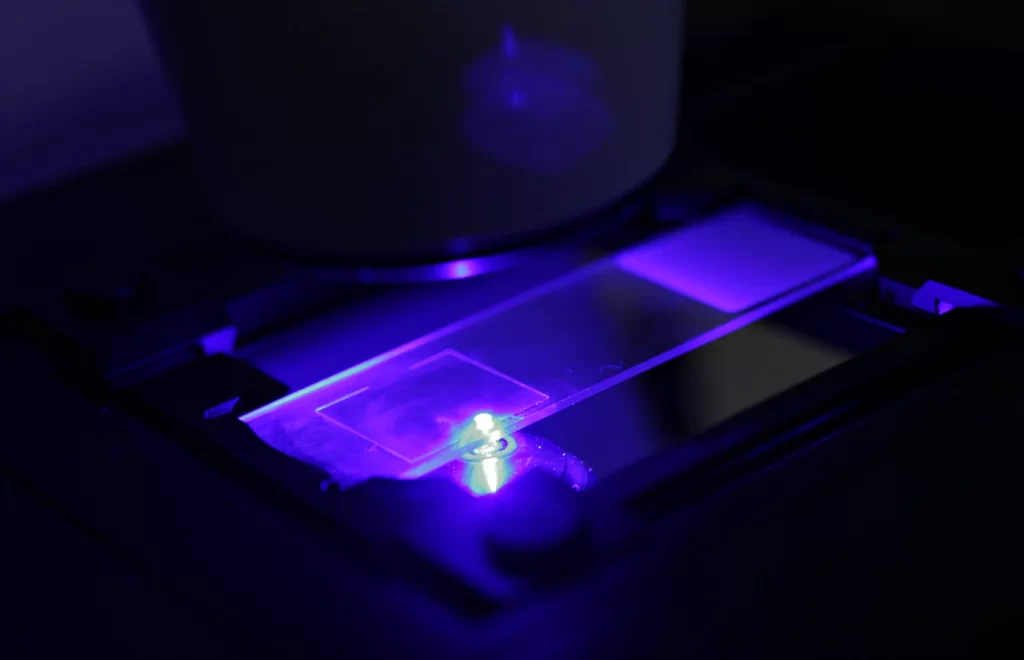
A fluorescence spectrometer measures the light emitted by a molecule when it is excited by a specific wavelength of light.
A fluorescence spectrometer works by exciting molecules in a sample with UV or visible light. The molecules absorb the energy and emit fluorescence at a longer wavelength. The emitted light is measured by a detector and recorded as a fluorescence spectrum.
Steady-State Fluorescence
- Measures average fluorescence intensity.
- Most common method in chemical and pharmaceutical analysis.
- Used for concentration determination.
Fluorescence Lifetime
- Measures how long a molecule stays in the excited state before emitting light.
- Typical lifetime: 10⁻⁹ seconds (nanoseconds).
- Used for molecular interactions and advanced research.
Specification:
- Excitation wavelength range: 200-900 nm
- Emission wavelength range :200-900 nm
- Light Source -Xenon arc lamp: (150W or 450 W)
- Spectral bandwidth / slit width: 1-20 nm adjustable
- Wavelength repeatability: ±0.1 nm
- Detector: Photomultiplier tube
Applications:
A fluorescence spectrometer is used to detect and analyze substances that emit fluorescence when excited by UV or visible light. It is widely used because it is very sensitive and can detect very low concentrations.
Pharmaceutical Analysis
• Drug identification
• Impurity detection
• Drug concentration determination
• Dissolution studies
• Quality control of pharmaceutical products
• Drug identification
• Impurity detection
• Drug concentration determination
• Dissolution studies
• Quality control of pharmaceutical products
Environmental Analysis
• Detection of pollutants in water
• Analysis of organic contaminants
• Monitoring environmental toxins
• Detection of pollutants in water
• Analysis of organic contaminants
• Monitoring environmental toxins
Clinical and Medical Applications
• Disease diagnosis
• Biomarker detection
• Blood and urine analysis
• Disease diagnosis
• Biomarker detection
• Blood and urine analysis
Food and Agriculture Applications
• Detection of vitamins (e.g., Vitamin B2)
• Food quality analysis
• Detection of contaminants in food
• Detection of vitamins (e.g., Vitamin B2)
• Food quality analysis
• Detection of contaminants in food
Material Science Applications
• Study of semiconductors
• Analysis of nanomaterials
• Investigation of optical materials
• Study of semiconductors
• Analysis of nanomaterials
• Investigation of optical materials
Material Science Applications
• Protein and enzyme analysis
• DNA and RNA studies
• Cell imaging
• Fluorescent labeling studies
Ready to Work With Podhikai Scientific?
Take the next step in strengthening your laboratory or research facility with
reliable scientific instruments. Contact us to discuss your requirements or
learn more about our solutions.